


Back to Blogs
Discover
A Time of Witches: Discover the real Bury St Edmunds locations that inspired Madeline Martin's Book
Step into the pages of A Time of Witches: Discover the real Bury St Edmunds locations.
What if you could step into the pages of a novel and explore the very streets, buildings and landscapes that helped inspire its story?
In her latest novel, A Time of Witches, New York Times bestselling author Madeline Martin takes readers back to 1645 and the dark days of the witch trials in Bury St Edmunds providing an important backdrop to her gripping tale.
Set across two timelines, the novel explores the lives of women separated by centuries but connected through themes of family, identity, fear and the power of female relationships.
Madeline travelled from her home in Florida to Bury St Edmunds to research the town's fascinating and often harrowing history. During her visit, she explored its historic streets, visited local landmarks and worked with Bury's knowledgeable tour guides and the team at Moyse's Hall Museum.
Many real Bury St Edmunds locations feature in the story, giving readers the opportunity to discover the town for themselves.
Whether you've already read the book or are planning to pick up a copy, here are some of the real places to look out for.
Abbeygate Street – a walk through history

One of Bury St Edmunds' most recognisable historic streets, Abbeygate Street is a wonderful place to begin exploring the town's connections with the novel.
With its historic buildings, shops and fascinating architectural details, it's easy to imagine the centuries of stories held within these streets.
The medieval layout of Bury St Edmunds remains a distinctive part of the town today. As you wander along Abbeygate Street, take time to look up at the buildings and imagine how different life would have been here in the 17th century.
The River Lark – a quieter side of Bury

The River Lark is another real Bury St Edmunds location connected with Madeline's story.
Flowing alongside the beautiful Abbey Gardens, the river forms part of the historic landscape surrounding the remains of the former Benedictine Abbey.
Today, it's a lovely place to enjoy a peaceful walk, discover the town's green spaces and take in a different perspective of Bury St Edmunds.
It's a reminder that the town's history isn't just found in its buildings and streets, but also in the landscape that has shaped it over the centuries.
Sybil Andrews – the real woman behind the name

Sybil Andrews' family home at 88–90 Guildhall Street
One of the most interesting real-life connections in A Time of Witches is the inspiration behind the name of its central historical character, Sybil.
Madeline named her character after Sybil Andrews, the celebrated artist who was born in Bury St Edmunds in 1898.
Andrews became internationally recognised for her striking modernist linocut prints, but her story began right here in Suffolk.
She was born in a flat at 88–90 Guildhall Street (there is a blue plaque on the building), and her family later lived at 117 Northgate Street, where she attended the local art school.
It's a lovely connection between a fictional character living in the 17th century and a real woman whose artistic achievements became part of Bury's cultural heritage.
Skinner Street – discover the historic streets

Another of the town's historic streets to explore is Skinner Street and there's a reason this is featured in the town's ghost tours - it's one of the most spookiest streets at night!
Just a short walk from Abbeygate Street and the town centre's other historic landmarks, Skinner Street is part of the network of streets that gives Bury St Edmunds so much of its character.
One of the pleasures of exploring the town is discovering how much of its historic street pattern survives today.
Take a wander through these older parts of Bury and imagine the people who would have walked the same streets centuries ago, when the town was a very different place.
The Nutshell – a chilling connection with the witch trials

One of the more intriguing locations connected with the history explored in A Time of Witches is the site of today's famous Nutshell pub.
The Nutshell itself wasn't here in 1645, but local history tells us that a building on this site was associated with the treatment of people accused of witchcraft.
During the witch trials, accused witches were taken there to have locks of hair and their fingernails removed as described in Madeline's book. These were reportedly stored in brown jars, as it was believed that if someone died without being physically whole, they would be unable to return as a witch in the afterlife.
It's a particularly unsettling detail, and one that features in Madeline's novel.
Today, The Nutshell is famous for being Britain's smallest pub (it's in The Guiness Book of Records), but its location has a much darker historical association.
It's a fascinating reminder of how the stories behind seemingly ordinary places can reveal some of the most extraordinary chapters in a town's past.
Moyse's Hall Museum – discover the real witch trials

For anyone wanting to discover the real history behind A Time of Witches, a visit to Moyse's Hall Museum is a must and gets a well deserved mention in A Time of Witches when Lillith goes to explore her past in Bury St Edmunds.
Housed in a remarkable medieval building overlooking Cornhill, the museum explores the history of Bury St Edmunds, including its connections with witchcraft, superstition and the infamous witch trials.
It was also an important stop during Madeline's research visit, where she spent time with museum staff learning more about the town's history.
Two particularly significant episodes in Bury's witch trial history took place in the 17th century.
In 1645, sixteen women and two men were convicted of witchcraft and executed in Bury St Edmunds on 27 August. Their trials were overseen by Matthew Hopkins, the self-styled Witchfinder General.
Then, in 1662, two women from Lowestoft, Rose Cullender and Amy Denny, were tried at Bury St Edmunds Assizes. Their case became particularly significant because the printed account of the trial, A Tryal of Witches, later influenced discussions of witchcraft and evidence across the Atlantic, including in Salem, Massachusetts.
Visitors can discover more about these events, a beautiful memorial to the victims and see the remarkable historic publication, which provides a tangible link between Bury St Edmunds and Salem.
It's a fascinating opportunity to explore the real people and events that helped inspire Madeline's novel.
Bury St Edmunds Tour Guides – bringing history to life

Madeline with the Tour Guides
Behind every great historical novel is research, and Madeline's visit to Bury St Edmunds involved plenty of it!
In fact, Madeline set a rather impressive record for our town guides, taking six guided tours over just two days!
Working with members of Bury St Edmunds Tour Guides, she explored the town's fascinating past, from medieval life and Tudor times to crime, punishment, ghostly tales and the stories of some of its most notorious residents.
John Saunders, Lynn Whitehead, and Terry O'Donoghue were among the guides involved in helping Madeline bring the town's history to life.
Madeline's enthusiasm for discovering the real stories behind the streets and buildings was clear, and the knowledge shared by our guides helped provide valuable historical context for her writing.
If you'd like to discover more about the history behind the novel, why not join one of our guided town tours?
Our knowledgeable guides bring centuries of history to life, revealing the fascinating stories behind the buildings, streets and people of Bury St Edmunds.
Come and discover the history for yourself
From medieval streets and riverside walks to fascinating museum collections and centuries-old stories, Bury St Edmunds offers plenty for readers of A Time of Witches to explore.
Madeline Martin's novel brings an extraordinary period of our history to life, but the real stories of the people who lived here are just as compelling.
Whether you're visiting because you've read the book, have an interest in the witch trials or simply love exploring historic places, we'd love to welcome you to Bury St Edmunds.
Come and walk in the footsteps of history.
Related Blogs
News
Abbeygate Cinema Voted One Of…
Abbeygate Cinema has been voted one of the 5 best…
News
Horror isn’t just for…
Horror is not just for Halloween in West Suffolk where…
News
First Memorial for Victims of…
New memorial at museum will focus on the victims and a…
News
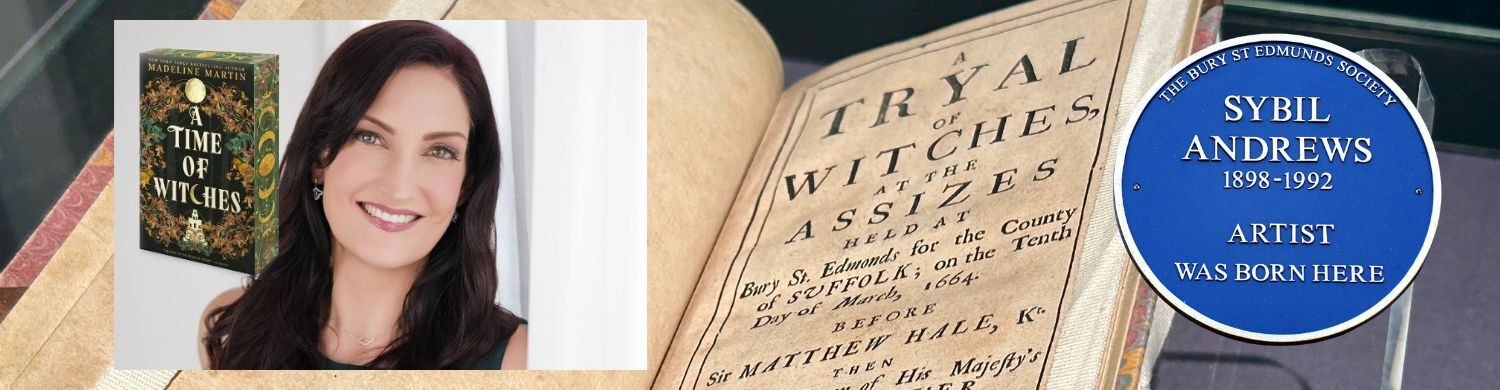
From America to Bury St…
Discover how Bury St Edmunds’ dark history inspired…

News
Bury St Edmunds Literature…
Line-Up for Bury St Edmunds Literature Festival 2026…
Latest news

News
A Time of Witches: Discover the real Bury St Edmunds locations that inspired Madeline Martin's Book
Step into the pages of A Time of Witches: Discover the real Bury St Edmunds locations.

News
Abbeygate Cinema Voted One Of The Top 5 Best Cinemas in the UK
Abbeygate Cinema has been voted one of the 5 best cinemas in the UK in the British Independent Film Awards’ (BIFA) Cinema of the Year awar.

News
Memorial to Honour the Victims of the Witchcraft Trials in Bury St Edmunds Unveiled
A first memorial to honour the victims of the witchcraft trials in Bury St Edmunds by Kate Jackson and John Williams has been installed at Moyse’s Hall Museum.

News
High Demand for Town Tours
Record Breaking Year for Bury St Edmunds Tour Guides Ghostly and Maacabre Walks!

News
Horror isn’t just for Halloween at Moyse’s Hall
Horror is not just for Halloween in West Suffolk where visitors will have plenty to sink their teeth into at a new exhibition that opens this weekend.

News
Bury St Edmunds reaches Dog Friendly Awards finals for fourth year running
The historic Suffolk town won the title of the UK’s Most Dog Friendly Town in 2024, and is now hoping to reclaim the title.

News
First Memorial for Victims of the Bury St Edmunds Witchcraft Trials
New memorial at museum will focus on the victims and a new play will bring to life the trial that links Bury St Edmunds to Salem.

News
St Edmundsbury Cathedral Launches 2027 Dogs In The Cathedral Calendar
Twelve local dogs were photographed for the 2027 calendar!

News
Where to See Santa in Bury St Edmunds
Our guide to where you can see Santa this Christmas in Bury St Edmunds!
